
In the Kansas City area, termite swarmers typically show up on the first warm, humid day after a rain, usually somewhere between February and May. Some homes see a smaller second wave in the fall. If you’re seeing winged insects near a windowsill, foundation crack, or light fixture right now, the timing lines up. The next step is figuring out whether they’re termites or ants, because the fix (and the urgency) is different for each.
If you just watched a handful of winged bugs crawl out of a crack near your foundation, or found a small pile of them dead on a windowsill, you’re probably trying to answer one question: termites or ants? That’s the right question to ask before you do anything else.
When is termite season in Kansas City?
Around here, “termite season” isn’t one single week on a calendar. It’s tied to weather, not the date. Subterranean termites (the species we deal with most in this region) send out reproductive swarmers when the soil warms up and there’s enough moisture in the air, which typically means a stretch of days from February through May, often right after a rain. Warm, humid, calm air is basically a green light for a swarm.
That said, weather doesn’t read a calendar either. A mild stretch in late January or an unusually warm, wet week in October can trigger swarming activity outside the “typical” window. So while spring is the main event, don’t assume you’re in the clear just because it’s technically winter.
Are termites active in summer and winter here?
The termites themselves, the actual colony underground, are active nearly year-round in the Kansas City area. They don’t hibernate the way some insects do. What changes with the seasons is swarming behavior specifically. Swarms (the winged reproductives leaving the nest to start new colonies) are a spring phenomenon primarily, with a possible smaller fall swarm in some colonies. But the colony feeding on wood in your crawl space or wall doesn’t take a summer or winter break. Cooler weather just slows things down a bit rather than stopping them.
That’s worth knowing because a lot of homeowners assume, “it’s winter, so we’re fine.” Termites don’t operate on that assumption, and neither should you. Pest control in Olathe, KS can help identify and address termite activity before it leads to more serious damage.
Termite swarmers vs. flying ants: how to tell the difference
This is the part most people actually need help with, since the two look similar enough at a glance to cause real confusion. Here’s a side-by-side.
| Feature | Termite Swarmer | Flying Ant |
| Wings | Two pairs, equal in length and shape | Two pairs, front pair noticeably longer than back pair |
| Body shape | Straight, no pinched waist | Pinched, narrow “wasp-like” waist |
| Antennae | Straight, almost bead-like | Bent or “elbowed” |
| Body color | Dark brown to black, soft-bodied | Varies, often darker with a harder-looking body |
| Wings after landing | Often shed in a pile nearby (discarded wings are a strong tell) | Less commonly shed in obvious piles |
| Typical behavior | Weak, clumsy fliers, often found near windows, foundation cracks, or light sources indoors | Fly reasonably well, more commonly seen outdoors around plants or food sources |
If you can get a close look (or a decent photo) at the waist and antennae, that’s usually enough to settle the question. A straight waist and straight antennae point to termites. A pinched waist and bent antennae point to ants.
What do winged termites look like?
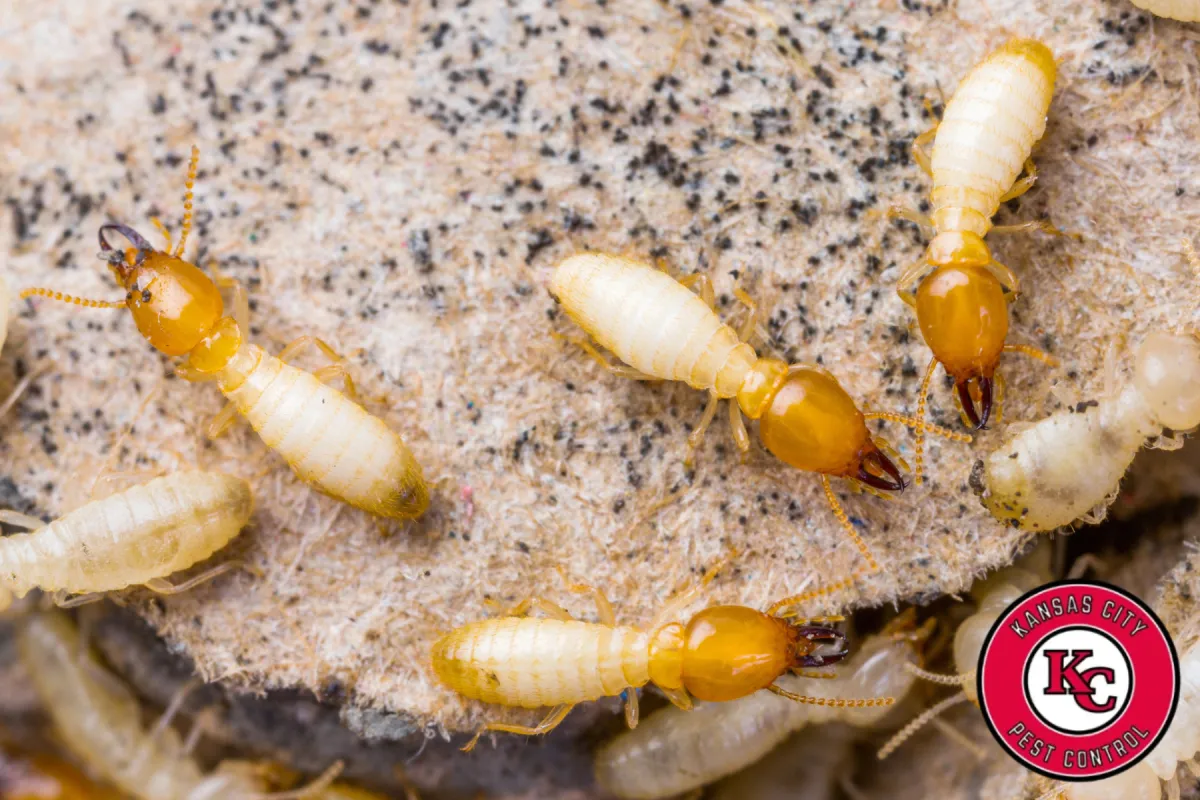
Termite swarmers (also called alates) are soft-bodied insects, usually dark brown to black, somewhere in the neighborhood of a third to half an inch long, including the wings. The two pairs of wings are the same length and shape and extend well past the body, which is one reason people mistake them for large ants at first glance. Once they land and shed those wings looking for a mate, you’re often left with a small scattering of translucent, uniform wings on a windowsill or floor, which by itself is a pretty reliable sign of what you’re dealing with, even if you never see the bug itself again.
Drywood termites also swarm and look similar, but subterranean termites are the species we deal with most in Missouri and Kansas, since our climate and soil conditions favor them. Subterranean termites live in the soil and need contact with moisture to survive, which is part of why mud tubes, wood-to-soil contact, and foundation moisture matter so much in this region.
Why are there suddenly flying insects in my house?
A few things usually explain a sudden appearance of winged insects indoors. It could be a termite swarm triggered by recent rain and warm temperatures, especially if there’s wood-to-soil contact somewhere on the property (a porch post set directly in dirt, mulch piled against siding, a deck touching the ground). It could also be flying ants doing the same seasonal mating flight thing termites do, just for a different species. Less commonly, it’s some other seasonal insect that happens to have wings this time of year.
Older homes in neighborhoods like Brookside and Waldo, along with plenty of other established KC neighborhoods, tend to have more wood-to-soil contact built into their original construction than newer builds do, and the area’s clay soil holds moisture longer after a rain than sandier soil would. That combination (moisture retention plus wood touching the ground) is exactly the setup subterranean termites look for. It doesn’t mean every older home has termites. It does mean the conditions that produce a swarm are common in this part of town.
Do termite swarmers mean I already have an infestation?
It depends on where you saw them, and this distinction matters more than almost anything else in this article.
Swarmers seen outdoors, away from the house, especially near tree stumps, mulch beds, or old wood in the yard, are common and don’t necessarily mean your house has a problem. Termites swarm from established colonies in the soil all over the area, including colonies that have nothing to do with your home.
Swarmers seen indoors are a different story. If winged termites are emerging from inside your house (a window frame, baseboard, or a crack in an interior wall), that generally means there’s an active colony connected to your home’s structure. Indoor swarms are one of the more reliable warning signs of an existing infestation, not just a “might happen someday” risk.
Other signs worth checking for at the same time include mud tubes running along your foundation wall (usually about the width of a pencil), wood that sounds hollow when tapped, small piles of discarded wings along interior window sills or door frames, and any wood-to-soil contact around the perimeter of the house. If you notice these warning signs, pest control in Olathe can help identify whether termites are active.
What should I do if I see swarmers?
First, don’t spray them with a can of bug killer and call it done. That might kill the handful you can see, but it does nothing about a colony that could already be established. Try to get a photo if you can, since that helps confirm whether you’re looking at termites or ants before anyone even shows up. Note where you saw them (indoors or outdoors, and roughly where) and whether you noticed any discarded wings nearby.
From there, the most useful next step is having someone take a look at the actual structure, not just the bugs on the windowsill. That’s what an inspection is for. Olathe pest control professionals can check the foundation, crawl space, and any wood-to-soil contact points around the property, so you’re getting an answer based on what’s actually going on with your house instead of guessing from a photo.
Frequently Asked Questions
How long does a termite swarm usually last?
An individual swarm event is usually short, often just an hour or two on a given day, though a colony can produce swarmers on more than one occasion across the season.
Can I get rid of termite swarmers with a store-bought spray?
You can kill the swarmers you see, but that doesn’t address the colony they came from. If the swarm originated indoors, spraying the visible bugs won’t solve the underlying problem.
Do termite swarms mean the termites are about to spread through my whole house?
Not immediately, but an indoor swarm does mean there’s an established colony connected to the structure, which is worth addressing rather than waiting on.
Is it normal to see termite swarmers every single spring?
Seeing a swarm outdoors in your yard some years isn’t unusual given how common termite colonies are in soil throughout the region. Seeing swarmers indoors, though, isn’t something we’d call expected.
What’s the difference between subterranean and drywood termites?
Subterranean termites live in the soil, need contact with moisture, and are the species most commonly found in Missouri and Kansas. Drywood termites live inside the wood itself without needing soil contact and are far less common in this climate.
About Kansas City Pest Control
Kansas City Pest Control provides professional, reliable pest solutions for homes and businesses across Kansas City, Overland Park, and Olathe. With safe treatments, regional expertise, and a focus on lasting results, the team helps customers protect their properties with confidence and peace of mind.
If you’re seeing swarmers at your house, don’t wait around guessing. Call us today for an inspection; we’re local, experienced, and ready to help, and if pests come back after treatment, we’ll return and re-treat at no additional cost.